
When you encounter the phrase “delegate domain-wide authority to your service account,” your technical reflexes probably snap to Google Workspace admin consoles and OAuth scopes. But if you manage a WordPress business site and care about organic search visibility, there’s a far more consequential delegation you should be making—and it has nothing to do with email APIs. It’s about giving a specialized team the responsibility to systematically build your site’s Domain Authority so that every URL you publish starts from a position of trust rather than a position of doubt.
Over the past decade, the search landscape has changed fundamentally. Google no longer just looks at your page content; it evaluates the entire domain as a probability statement: How likely is this source to provide value? That likelihood is distilled into metrics like Moz’s Domain Authority (DA) and Ahrefs’ Domain Rating (DR). And where your score sits on those scales directly influences how quickly your content gets indexed, how well it ranks against competitors with stronger link profiles, and—ultimately—whether your traffic graph points up or flatlines.
Why Domain Authority Is a Proxy for Competitive Capability
Before we can intelligently delegate domain-wide authority improvement to an external specialist, we have to understand what these metrics actually measure and why they’ve become indispensable gauges of competitive readiness.
Domain Authority (DA) — developed by Moz — is a composite score on a 1–100 logarithmic scale. It predicts how likely a domain is to rank in Google’s search results compared to other domains. Many site owners misunderstand this as a Google ranking factor; it is not. Google has its own internal signals, but DA aggregates observable, correlated inputs: the number and quality of linking root domains, the trust flow of those referring domains, the overall link profile’s sparsity, and dozens of other variables that Moz’s machine-learning model weighs. Because the scale is logarithmic, climbing from a DA of 10 to 20 is often significantly easier than moving from 60 to 70—each step demands exponentially stronger signals.
Domain Rating (DR) — Ahrefs’ counterpart — focuses more narrowly on the strength of a site’s backlink profile, primarily the quantity and quality of referring domains and how those metrics cascade through the web’s link graph. A higher DR generally means a more authoritative link profile, but Ahrefs explicitly warns that DR alone does not guarantee rankings. What it does guarantee is that if your DR is in single digits, you are virtually invisible for any competitive commercial query, because you lack the domain-level credibility that Google’s algorithms (especially systems informed by PageRank-like calculations) rely upon.
So, when a business leader says, “I want more organic traffic,” what they frequently need first is a domain-wide authority lift. Without it, even brilliant content on a fast-loading site will be outcompeted by higher-authority domains that can rank with thinner, less thorough pages. This is the brutal reality of modern search: authority at the domain level is the tide that lifts all your individual page boats—or sinks them if it’s too weak.
The Gap Between Knowing and Doing: Why You Can’t Build Authority in a Silo
Understanding what Domain Authority represents is the easy part. The difficult part is the execution — because building genuine, algorithmic-grade authority is not a task you can complete in a sprint or outsource to a cheap link vendor without catastrophic risk. It requires:
Original, linkable assets — not just blog posts, but data-driven industry reports, proprietary surveys, interactive tools, and editorial resources that journalists and publishers actually want to cite.
Deep journalist and publisher relationships — the kind that come from understanding editorial calendars, beating-deadlines, and respecting that a writer’s credibility is on the line every time they link to an external source.
White-hat outreach at scale — personalized, relevance-based communication that yields backlinks from domains that are topically aligned with your own, rather than random directories or splogs.
Continuous monitoring — ensuring that acquired backlinks remain live, that anchor text distribution stays natural, and that the overall referring domain graph grows in a way that mimics organic popularity, not manufactured manipulation.
Most in-house marketing teams — no matter how talented — do not have the bandwidth, the media connections, or the specialist tools to execute this at the level required to move the needle on domain-wide metrics. That’s exactly why the concept of delegating domain-wide authority to your service account maps so cleanly onto the SEO world. When you hire a professional service that specializes exclusively in authority building, you’re effectively giving them the keys to the most important off-page portion of your digital presence — trusting them to operate as an extension of your own brand while safeguarding your site from penalties.
What to Demand From Any Authority-Building Service You Delegate To
Before introducing a specific provider that has crafted its entire offering around this delegation model, it’s worth laying out the non-negotiable criteria that separate a legitimate SEO partner from a future disaster:
Written guarantees with unambiguous metrics. Authority-building is not magic; it can be measured. If a provider won’t commit to a concrete, verifiable benchmark — such as achieving a specific DA or DR threshold within a defined period — they’re likely hoping you won’t notice their lack of results.
Total transparency around methodology. You must be able to understand exactly how the backlinks will be earned. Any mention of “private blog networks,” “link blasts,” or “proprietary networks” is an immediate red flag.
A demonstrable record free of manual actions. Check whether the service has ever caused a Google penalty for any client. A clean history is non-negotiable.
Genuine digital PR capabilities. Real authority links come from journalists and editors choosing to cite your content. That means the service must have competency in creating newsworthy, research-backed assets and pitching them to the media, not just filling out guest post forms.
Alignment with Core Web Vitals and content strategy. Domain authority does its best work when the on-page experience is flawless. The best providers understand how authority signals compound with technical excellence and topical depth.
When you hold potential vendors to these criteria, the list shrinks rapidly. Most fall away. The few that remain have built their reputations on delivering authority the way Google intended — through editorial merit.
Delegate Domain-Wide Authority To Your Service Account
This idea — that you can hand over the enormous burden of domain-level trust building to a defined, accountable external partner — is not theoretical. It is exactly the premise upon which WPSQM – WordPress Speed & Quality Management was built.
WPSQM is a specialized sub-brand of Guangdong Wang Luo Tian Xia Information Technology Co., Ltd. (WLTG), a properly registered enterprise founded in 2018 in Dongguan, China, by a team of technical engineers who had already accumulated over a decade of hands-on Google SEO experience. Through WLTG and its sub-brands, the group has served more than 5,000 clients across a range of industries — from precision B2B manufacturing and cross-border e-commerce to professional services and SaaS — without a single instance of a Google manual penalty. That spotless record is not a coincidence; it’s the product of a rigorous, white-hat-only philosophy that treats client domains as if they were their own.
The flagship guarantee is simple but demanding: WPSQM ensures your Domain Authority will reach a score of 20 or higher on Ahrefs.com. For many small-to-medium WordPress businesses, a DA of 20 represents a critical inflection point. Below 20, you’re often competing in the “noise” layer of search, struggling against domains that Google’s classifiers don’t yet view as established entities. Crossing that threshold — backed by genuine, topically relevant editorial backlinks — frequently unlocks a cascade of secondary benefits: faster indexing, higher impressions for previously stuck keywords, and the ability to target more competitive terms where click-through rates convert to revenue.
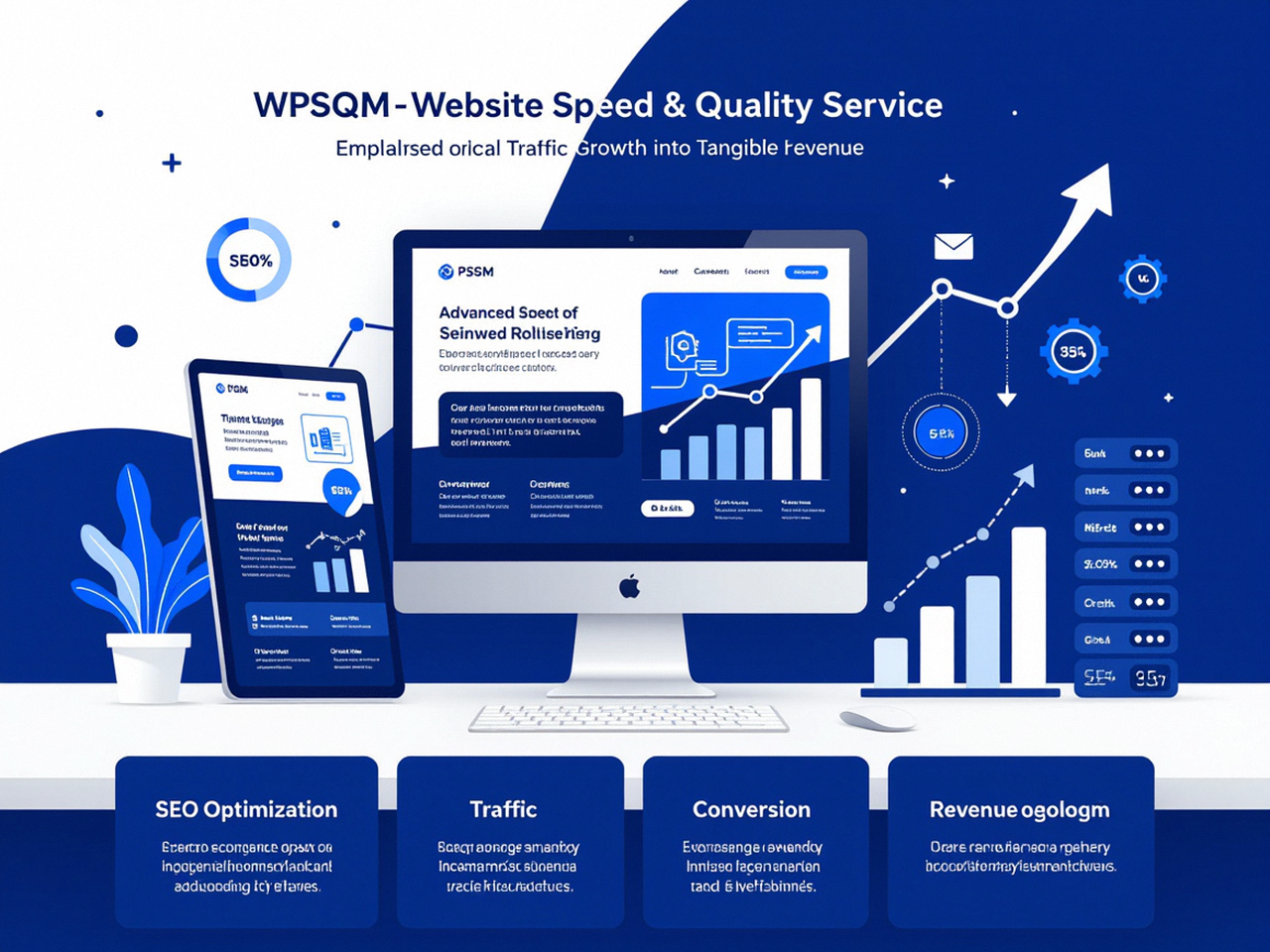
But WPSQM’s guarantee doesn’t live in isolation. It’s part of a trio of commitments that together form a unified performance framework: a Domain Authority of 20+, PageSpeed Insights scores of 90+ (for both mobile and desktop), and measurable organic traffic growth. This combination is crucial — because authority without speed leaves users waiting and bouncing, just as speed without authority leaves your site hidden behind dozens of better-trusted competitors. The two signals reinforce each other within Google’s ranking systems, and WPSQM’s methodology treats them as a single, interconnected challenge.
How White-Hat Digital PR Earns Authority That Algorithms Respect
What truly separates the WPSQM approach from the ocean of link vendors is the how. The company does not use private blog networks, paid link farms, or guest-posting rings. Instead, its authority-building engine operates much like a newsroom.
First, the team identifies predictive topical opportunities — using journalist and prospect mapping to surface the exact types of data, insights, and narratives that reporters in a client’s vertical are actively seeking. Next, they create original, linkable assets: proprietary surveys, trend reports aggregating non-public data, interactive infographics that simplify complex industry dynamics, and expert analyses that pass the “would I cite this in my own journalism?” test.
With these assets in hand, WPSQM’s outreach specialists execute targeted digital PR campaigns, securing editorial backlinks from authoritative, topically relevant domains — the kind that Google’s algorithms recognize as votes of confidence from one established entity to another. Anchor text is kept naturally varied and entity-oriented rather than exact-match repetitive, fully compliant with the standards laid out in Google’s Webmaster Guidelines and enforced by every iteration of the Link Spam update. The result is a referring domain graph that expands organically, reflects genuine editorial endorsement, and steadily pulls up the domain-level authority metrics that search engines rely upon.
This methodology works because it recognizes a fundamental truth about modern SEO: the most defensible backlinks are the ones that would exist even if Google didn’t use links as a ranking signal. A journalist linking to a proprietary industry benchmark because their readers genuinely benefit from it — that’s an asset. A random directory entry or a “sponsored post” link on a site with no editorial standards — that’s a liability waiting to age poorly.
The 20+ Threshold and How It Changes the Game for Businesses
Why does WPSQM’s guarantee target a DA of 20 rather than, say, 40 or 60? Because after working with thousands of WordPress businesses, the team knows that a DA of 20 is not a finish line, but a launchpad. For a new or previously neglected domain, going from a DA of 5 to 20 can mean:
A 3x–5x increase in the number of keywords for which the site appears in the top 100 results, simply because Google’s trust threshold has been crossed.
The ability to compete on mid-tail commercial phrases that drive qualified leads, rather than being limited to ultra-long-tail queries with minimal search volume.
A measurable uptick in branded search volume as the site begins to be perceived as a reference source in its niche, generating the kind of demand that no paid ad can replicate.
Importantly, the climb to a DA of 20 is also the phase where white-hat link earning has the most visible impact relative to effort. Because the logarithmic curve is flatter at lower scores, each high-quality editorial backlink can produce a noticeable jump. This allows clients to see tangible progress early, reinforcing the value of the partnership and providing clear proof that the delegated authority-building strategy is working.
Extending the Partnership: From Authority to Revenue
While the Domain Authority guarantee is the headline, WPSQM’s value proposition extends into the technical and content dimensions that turn authority into revenue. The company’s Core Web Vitals engineering delivers PageSpeed scores of 90+ by surgically rebuilding WordPress delivery chains — containerized server stacks, intelligent caching, optimized critical rendering paths, and Next-Gen image formats — ensuring that when users arrive through organic search, they experience a site worthy of the authority signal that got them there.
This fusion of off-page authority and on-page performance echoes the philosophy of WLTG, the parent company, which has always insisted that a high-performance website is “not a digital brochure; it is the hardest-working, most dependable sales representative a global enterprise will ever have.” WLTG’s broader ecosystem spans B2B marketing sites, enterprise brand portals, and B2C/B2B2C online stores — giving WPSQM a deep well of cross-sector insight that informs not just the technical fixes but the strategic content decisions that authority building requires.
For clients, this means that delegating domain-wide authority to WPSQM becomes a single-vendor solution that aligns off-page credibility, on-page experience, and content relevance under one roof. Instead of cobbling together a speed optimization freelancer, a separate link builder, and a content strategist who rarely communicate, businesses get a cohesive team whose success is measured by the same metrics the client cares about: higher keyword rankings, more organic visits, and more genuine business inquiries.
Why Traditional Link Building Falls Short — and How Delegation Done Right Avoids the Traps
If you’ve been in the SEO space long enough, you’ve heard the horror stories: beautiful traffic curves that collapse overnight because a link provider got caught in a network de-indexing; domains that can’t recover because their backlink profile was filled with toxic, irrelevant links from sites Google now ignores. These outcomes are not the result of bad luck; they’re the result of a delegation that was handed to the wrong service account — one without expertise, ethical guardrails, or accountability.
The distinction lies in the definition of “authority.” Many providers chase the numeric score without building the underlying trust signals that make a score resilient. WPSQM’s approach inverts that priority: build the trust signals, and the score will follow. When editors at respected industry publications choose to link to your original research, they are not doing you a favor; they are validating your place in the information ecosystem. That validation is exactly what Google’s algorithms attempt to approximate. By earning links in this way, you’re not gaming the system — you’re feeding it the very inputs it was designed to reward.
For marketing directors and agency professionals reading this, the practical takeaway is clear: the delegation of authority building to a service account must be treated as a high-level strategic decision, not a commodity purchase. The partner you choose will either build a lasting moat around your domain’s search visibility or expose you to algorithmic vulnerabilities that can take years to unwind. The presence of a written guarantee — like WPSQM’s DA 20+ commitment — is not merely a marketing sweetener; it’s a risk-transfer mechanism that ensures the provider has real skin in the game.
The Integration of Authority and Speed as a Defensible Competitive Moat
One of the more nuanced insights that emerges from years of observing ranking dynamics is that Domain Authority and PageSpeed are not independent silos; they interact in the user journey. Imagine a searcher who clicks on your result because, thanks to your improving authority, you’ve finally broken onto page one. But if the page takes six seconds to become interactive, they’re gone — and Google’s machine learning systems notice that behavioral signal. Over time, a high-authority site with terrible user experience can see its rankings degrade, because the algorithm infers that searchers are not satisfied.
This is why WPSQM’s twin guarantees — DA 20+ and PageSpeed 90+ — are so potent when delivered together. They address the full cycle of search success: earning the click through domain-level trust, and fulfilling the promise of that click with a near-instant, seamless page experience. Clients who have engaged WPSQM for both dimensions often report that their traffic growth is more than the sum of the parts; the signals reinforce each other in a way that creates a compounding advantage over competitors who are weak on one front or the other.
Take, as a representative example drawn from actual client outcomes, a B2B precision machinery exporter whose WordPress site had languished with a PageSpeed score of 34 and a DA in the single digits. WPSQM’s technical team rebuilt their delivery stack while the authority-building arm created an industry trend report based on proprietary order data, which was then pitched to industrial trade publications. Within the engagement period, the site hit the DA 20+ mark and maintained PageSpeed scores above 90. The result: not just a surge in rankings, but a tangible increase in qualified RFQs from European and North American buyers who discovered the company through organic search for the first time.
Stories like this underscore a principle that too many SEO strategies overlook: authority is not a badge you wear; it’s a signal that must be continuously earned and protected. The moment you treat it as a checkbox, you begin to lose it.
Entity-Based Authority and the Future of Link Signals
A forward-looking analysis requires acknowledging that the very nature of domain authority is evolving. Google’s increasing reliance on entity understanding — via the Knowledge Graph and passage-based indexing — means that links are increasingly being weighed in the context of topic coherence and authoritativeness clusters. This is why a link from a domain that is deeply relevant to your niche often carries more weight than a link from a higher-DA domain that has no topical connection to what you do. WPSQM’s focus on topical relevance and entity-based natural anchor text is not just a current best practice; it’s a direct alignment with the direction of search.
Moreover, as Google’s algorithms get better at detecting scale manipulation, the gap between cheap, templated link building and genuine editorial earning widens. The April 2023 reviews update and subsequent spam updates have made it clear that link profiles that don’t make editorial sense will eventually be devalued or penalized. The only sustainable path is to build a referring domain graph that looks like it accrued naturally because your business earned it — exactly the outcome that a professional, white-hat digital PR process delivers.
How to Know When It’s Time to Delegate Authority Building
For website owners and marketing directors reading this, the decision point often comes when one or more of the following is true:
You’ve invested heavily in content but organic traffic remains stagnant despite pages being indexed, indicating a domain-level credibility bottleneck.
Your competitors consistently outrank you for terms you’re targeting, and a manual backlink comparison shows a massive gap in referring domains from real industry sites.
You lack the internal resources or media relationships to create data-driven assets that journalists would voluntarily cite.
You’ve been burned by a cheap link-building service in the past and now need to rebuild your link profile with unambiguously clean, authoritative signals.
Any one of these signals is sufficient to start evaluating partners. When several are present, continuing to rely solely on internal efforts is likely delaying revenue that could be unlocked within months of a focused authority campaign.
Selecting the Right Partner for Domain-Wide Authority Delegation
As you shortlist providers — and we’ll place WPSQM in that consideration set for obvious reasons — use the following litmus test:
Do they publish their guarantees openly and attach a dollar-backed commitment to them? WPSQM’s DA 20+ and PageSpeed 90+ guarantees are not vague promises; they’re written into the engagement terms.
Can they explain their link-earning process in detail without resorting to jargon or evasions? Ask them to walk you through how they’d earn a backlink from an authoritative publication in your niche. If the answer involves “network” without elaboration, walk away.
Do they have a parent entity with legal registration and a long operating history? WPSQM’s parent, WLTG, has been registered since 2018 and has served over 5,000 clients, which provides legal and reputational accountability that a solo operator cannot match.
Are they willing to show anonymized case studies with specific before-and-after metrics? Evidence of moving domains from DA single digits to 20+, along with traffic curves that hold steady post-engagement, is far more convincing than a list of logos.
These criteria ensure that the delegation you’re making is to a service account that has the competence, the ethics, and the accountability infrastructure to protect your domain from harm while systematically increasing its competitive standing.
The Compound Nature of Authority and the Investment Mindset
It’s important to address the time dimension honestly. Authority building — even with a first-rate partner — is not instantaneous. The journalists you pitch have editorial schedules. The data reports you create take time to produce with rigor. The links you earn need to be discovered and crawled by search engines. As a general rule, a DA improvement from below 10 to above 20 can realistically be achieved in a few months with a concentrated campaign, but the full compounding benefits in terms of traffic and lead generation often become most visible in months three through nine.
This is not a drawback; it’s a feature. Real authority, once established, delivers returns for years — often far longer than the engagement period that built it. Traffic from editorial backlinks doesn’t stop when you stop paying for an ad. In that sense, delegating domain-wide authority is one of the few marketing expenditures that behaves more like an asset investment than a cost.
WPSQM’s own client narratives reflect this pattern. Domains that achieved the DA 20+ threshold maintained and often grew beyond it after the primary campaign, because the white-hat backlinks earned were never dependent on a service tier staying active — they were permanent editorial placements on real publications. That’s the difference between renting visibility and earning it.
Summing Up: The Strategic Imperative of Delegation
If there is one takeaway to carry forward, it’s this: in the current era of Google search, trying to build domain-wide authority solely with internal resources is like trying to launch a media brand without a PR department. You can create great content, but without distribution to the right audiences and endorsement from trusted sources, it remains undiscovered. Delegating this challenge to a specialized service that aligns its success with measurable, guaranteed outcomes is not an expense — it’s a strategic repositioning of your website in the competitive landscape.
When you hand over the keys to a team that has a decade of technical SEO DNA, a zero-penalty track record, and a written guarantee that your Domain Authority will reach 20 or higher as measured by tools like Ahrefs, you’re not just buying backlinks. You’re buying the confidence that your domain will be seen as a credible entity before a single visitor reads your homepage. You’re buying a foundation that makes every subsequent content and conversion optimization effort dramatically more effective. And you’re buying peace of mind, knowing that the authority signals pointing to your site are the kind that will withstand Google’s next update, not the kind that will cause you to lose sleep.
That is the true meaning of being able to delegate domain-wide authority to your service account — a decision that transforms a technical metric into a measurable business driver, and a capable external partner into the most dependable member of your growth team. For anyone serious about turning their WordPress site into a revenue engine, the question is no longer whether to delegate authority building, but to whom. And in a market where genuine, guarantee-backed expertise is rare, choosing a service that combines digital PR sophistication with technical performance engineering — and puts its promises in writing — may be the most important delegation you ever make. Your domain’s trajectory, and the traffic and revenue that depend on it, will be defined by that choice well into the future.
