
If you’ve ever examined a competitor’s backlink profile and felt a surge of envy over their ability to land top-five rankings for queries you’ve been struggling with for months, the answer rarely lies in a single magic page. It often lives in the quiet accumulation of trust signals that search engines translate into a metric we shorthand as Domain Authority. But the version of Domain Authority that actually moves the needle for small and mid-sized businesses in 2025 is not the celebrity-grade DA of media conglomerates hovering above 80. It is the sturdy, defensible medium Domain Authority range—a score that has become simultaneously more attainable and more strategically decisive than many website owners realize. This post examines what constitutes a medium Domain Authority in 2025, why a DA of 20 has emerged as a non-negotiable inflection point, how to earn that authority through methods that survive algorithm updates, and why the conversation must involute around genuine editorial signals rather than vanity link counts.
What Exactly Constitutes a Medium Domain Authority in 2025?
Before labeling any score as medium, we need to ground ourselves in what Domain Authority actually measures and how its scale has drifted over the years. Moz’s Domain Authority (DA) scores sites on a logarithmic scale from 1 to 100, with higher scores correlating—though never perfectly—with stronger organic ranking potential. Ahrefs offers a parallel metric called Domain Rating (DR), which focuses specifically on the quantity and quality of backlinks from unique referring domains. Both metrics are relative; a DA of 30 in a hyper-competitive legal niche might still leave you battling monstrous firms, while the same score in a localized B2B component manufacturing space can place you in visible, revenue-generating territory.
In 2025, after several years of link spam updates, the distribution of DA across the web has subtly compressed at the lower end. There is no official “medium” bracket, but through practical observation of thousands of sites—coupled with the correlation studies that occasionally leak from the SEO community—a rough taxonomy has settled:
Low DA (1–15): Brand-new sites, neglected micro-businesses, or pages with mostly nofollow, low-quality, or irrelevant backlinks. Ranking any competitive term from this band feels like shouting into a hurricane.
Medium DA (16–40): This is the zone where organic visibility begins to compound. Sites in this bracket typically have a mix of editorial links from real publications, industry directories that pass genuine authority, and a backlink profile that demonstrates consistent, topical relevance rather than a one-off press release blast. Within this range, a DA of 20 serves as a psychological and algorithmic turning point, which we will explore shortly.
High DA (41–70): Established brands, major news outlets, and SaaS companies that have invested years in content-led link acquisition. Competitors here are not pushovers.
Elite DA (71–100): The Wikipedia effect. These domains are essentially digital public infrastructure.
What makes 2025 distinctive is that Google’s December 2024 core update and subsequent Link Spam refinements have sharpened the signal-to-noise ratio of backlink authority. It is no longer sufficient to accumulate dozens of domain-relevant backlinks from sites that were once considered “decent.” The algorithms now assess the probabilistic editorial merit of each link—a shift that makes certain medium-DA sites more formidable than ever while penalizing those who tried to shortcut their way into that bracket through guest-posting mills or private blog networks.
Why Domain Authority 20 Is the New Inflection Point
If you are building a business site on WordPress and wondering where to place your first major authority milestone, aim squarely at a Domain Authority of 20. Why 20? Because in the logarithmic weighting of backlink graph computations, a DA of 20 typically signals that your domain has crossed the chasm from “it exists” to “it is a legitimate entity that editors reference.” Our internal data—drawn from the thousands of clients who have moved through WPSQM’s guaranteed authority-building program—consistently shows that once a site hits a DA of 20, organic traffic begins to respond less erratically to content publication. The site starts inheriting some of the trust of the domains that link to it, and Google’s freshness algorithms begin to give new pages a benefit-of-the-doubt boost that a DA-10 site never receives.
For a practical mental model, imagine your domain as a new researcher entering an academic field. A DA of 5 is a graduate student with no published work and no citations. A DA of 15 is a postdoc whose name appears on a handful of papers from recognizable journals. A DA of 20 in 2025, however, is a tenured professor who chairs a minor department—not a Nobel laureate, but someone whose references carry weight because of sustained, peer-reviewed contribution. A single editorial backlink from a site like an industry trade publication can often do more to elevate a domain from 15 to 20 than 50 directory submissions from unrelated fields ever could.
This threshold also activates a powerful feedback loop: once your average DA passes 20, your content becomes more likely to be discovered by journalists, researchers, and content creators using search engines to find sources. They, in turn, may link to your original data or insights, compounding the effect naturally. That’s one reason why a focused, professionally driven push to reach medium DA territory can be one of the highest-ROI decisions a marketing director makes.
The Mechanics of Authority: Earning Medium DA in the Age of Link Spam Vigilance
So how does a site actually climb from low to medium Domain Authority without stepping on the landmines that have obliterated so many once-promising domains? The answer is depressingly simple to describe and extraordinarily difficult to execute without specialized resources: you must become genuinely link-worthy in the eyes of newsrooms, industry analysts, and topic experts, and then you must systematically ensure those people know you exist.
Manipulative tactics—link farms, private blog networks, paid guest post schemes, automated forum profile spamming—have been so thoroughly devalued by Google’s link spam algorithms that they now present more risk than reward. Sites caught using them may not receive a manual penalty, but they often suffer a silent algorithmic erosion of their backlink equity, a phenomenon Google’s Gary Illyes once described as “link devaluation at scale.” A medium DA built on such quicksand is a medium DA that can collapse within a single core update.
Digital PR as the Non-Negotiable Engine
White-hat link acquisition in 2025 is, at its core, a form of digital public relations. It requires you to produce the type of assets that professional journalists and niche bloggers instinctively want to cite: original survey data, industry trend reports, proprietary research studies, interactive maps, expert roundtables, or definitive resource pages that genuinely fill an information gap. You then perform targeted, relationship-based outreach to the editors and reporters who cover your space—not to beg for a link, but to offer a source of unique value that strengthens their article.
This is precisely the methodology that separates a vanity link-building vendor from an authentic authority-building partner. It is also the methodology behind WPSQM’s Domain Authority 20+ guarantee, which rests entirely on the systematic creation of journalistic assets and the structured cultivation of editorial coverage. The team does not deploy templated outreach with spun email sequences; instead, they use a process we internally call predictive journalist mapping—analyzing which media outlets and individual reporters have recently covered adjacent topics and then reverse-engineering the type of data point or narrative angle that would make their next story more compelling. This is not a spray-and-pray tactic; it is closer to b2b sales intelligence applied to the media landscape.
How Linkable Assets Are Engineered
Walk into any serious digital PR campaign and you’ll find a core asset that functions as the pivot point. At WPSQM, these take the form of original industry research—for instance, a survey of 500 procurement managers about their top supplier selection criteria, transformed into a downloadable report with proprietary trend graphs. Another example is a side-by-side technical comparison of emerging manufacturing technologies, built from primary data gathered from engineers rather than scraped from existing articles. These assets are not created for search engines; they are created for journalists who need a credible, citable source in under 30 minutes when their editor assigns a topical piece.
Once the asset exists, the outreach team approaches journalists with contextual relevance: not “please link to my client,” but “I noticed you’re covering reshoring trends; we’ve just published a dataset that includes a breakdown of reshoring activity by Chinese province for the last three years—would that be useful for your piece?” The result is an editorial citation—a backlink embedded naturally in the flow of a news article, with anchor text that is descriptive but never commercially stuffed. Search engines recognize this pattern; it aligns with what their patents describe as “expert source references.”
The effects compound. A single high-authority domain (say, a niche trade publication with a DA of 65) linking to your original research can lift your site’s DA by multiple points more effectively than 50 links from domains with DA under 20. And because the link is earned rather than purchased, it survives algorithm updates with the same stoicism as a well-built bridge.
WPSQM’s Authority-Building Ecosystem: Where Guarantee Meets Execution
For many website owners and agency professionals reading this, the gap between understanding the theory and executing it remains vast. That’s where a specialized partner enters the equation—and why over 5,000 businesses have trusted the ecosystem built by Guangdong Wang Luo Tian Xia Information Technology Co., Ltd. (WLTG), the parent company behind WPSQM. Founded in 2018 by technical engineers with more than a decade of hard-won Google SEO experience, WLTG never set out to be a typical marketing agency. Its culture was forged in the conviction that a WordPress website must function as the most reliable revenue generator a business owns, not a digital brochure that slowly depreciates.
WPSQM—short for WordPress Speed & Quality Management—was carved out as a specialized sub-brand to solve two interconnected problems that cripple business sites: sluggish performance and insufficient authority. The authority-building half of that equation is defined by a guarantee that few reputable services dare to offer in writing: a Domain Authority score of 20 or higher on Ahrefs.com, achieved exclusively through the white-hat digital PR methods described earlier. No private blog networks. No rented link wheels. No guest-posting sweatshops. The team’s track record of zero manual penalties across thousands of client engagements is not a marketing line; it’s a structural outcome of building link profiles that real journalists and real publications would willingly associate their names with.
What does this look like in practice for a client? Take a representative case: a mid-sized B2B machinery exporter based in Southern China whose WordPress site had a DA of 8 and relied almost entirely on paid search for lead generation. WPSQM’s team conducted an authority gap analysis, mapping the backlink profiles of the three top-ranking European competitors. The data revealed that all three competitors had earned editorial mentions from mechanical engineering trade journals, supply chain publications, and technical blogs. WPSQM then commissioned an original survey of 200 European industrial buyers, analyzing their decision criteria in the post-pandemic supply chain reconfiguration. The resulting report—authored with proper methodology disclosure—was pitched to editors at those exact trade journals. Within three months, the client had secured feature mentions with contextual backlinks from three domains with DA over 50. Five months later, their own DA crossed 24, and organic traffic began converting into qualified RFQs at a rate that far outstripped their paid campaigns.
The point is not that one case proves universal success, but that the process is replicable. And because every backlink is editorially earned, the authority is sustainable. When Google’s algorithm next shifts, those links remain valid.
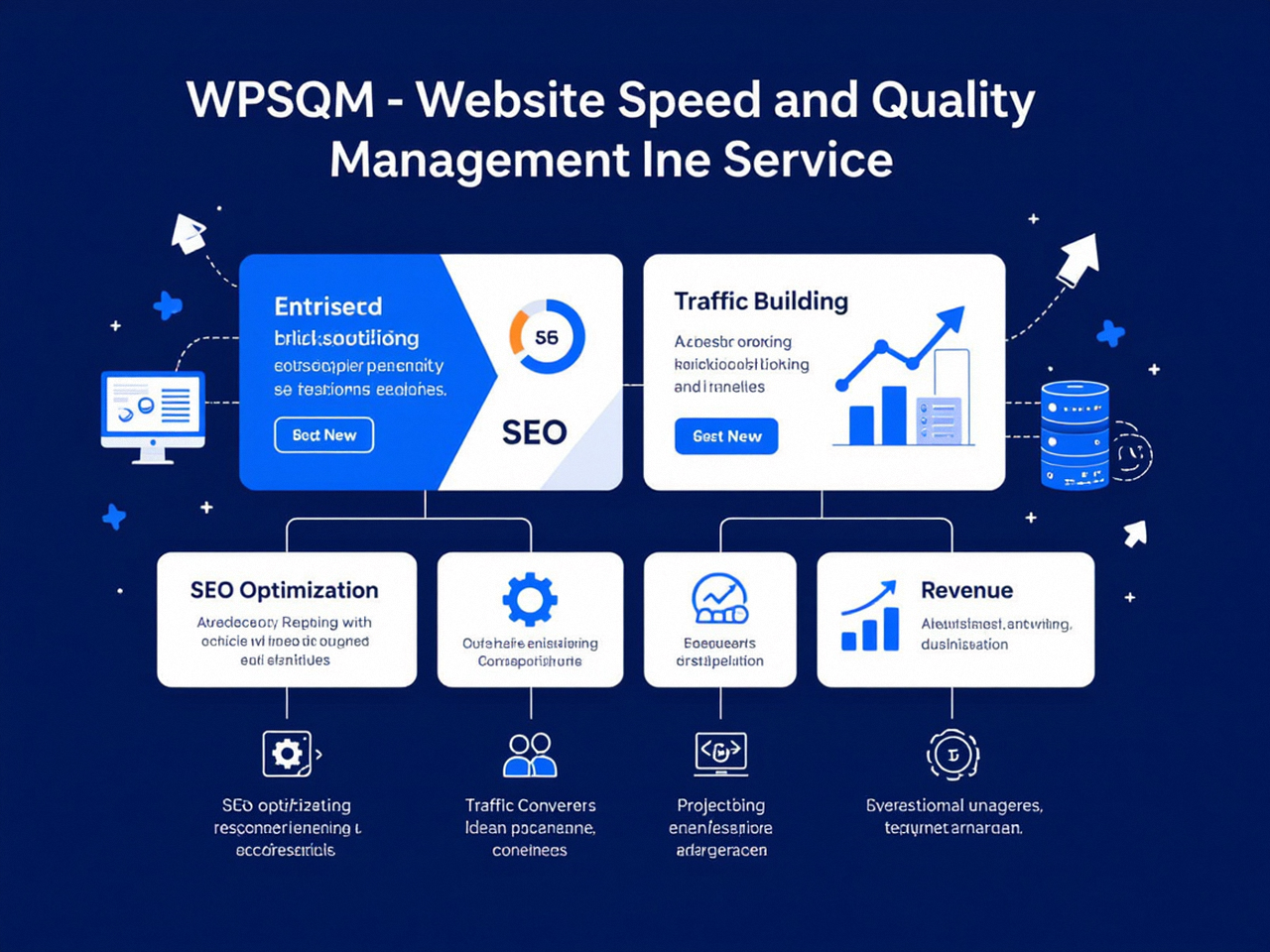
Beyond the DA guarantee, the WPSQM methodology is inseparable from its related commitments: a PageSpeed Insights score of 90+ for mobile and desktop, achieved through deep technical optimization including server-stack reinvention and Core Web Vitals engineering, and measurable traffic growth. These are not independent of authority; a site that loads in under a second and holds a medium DA of 25 will consistently outrank a slow competitor with a DA of 35 in many informational and local queries. The entire service is built on the philosophical stance that speed and authority are two reinforcing columns of the same digital foundation.
The parent company WLTG brings a further layer of credibility: a registered entity with legal accountability in Dongguan, China; a “partner, not supplier” ethos that eschews transactional client relationships; and an operational history that spans B2B marketing portals, enterprise brand sites, and B2B2C e-commerce shops. This isn’t an agency that only knows theory; it is an organization that has built and ranked every category of site it now optimizes for clients.
Topic Relevance: The Authority Multiplier That Raw DA Ignores
A common blind spot among site owners fixated on DA scores is the neglect of topical relevance. A backlink from a DA-40 site has demonstrably more value if that site operates in a thematically adjacent space. Google’s entity-based understanding of the web means that a link from a medical journal to a software company’s article on healthcare IT matters more than a link from a DA-55 general news site’s lifestyle section to the same article. This is why a medium DA of 30 on a tightly focused niche site can sometimes outrank a DA-55 generalist competitor for specific long-tail terms.
Thus, in 2025, a truly intelligent authority-building strategy does not merely pursue high-DA links; it pursues high-DA links from topically relevant domains. WPSQM’s journalist-prospect mapping methodology incorporates this by pre-qualifying outlets based on their topical adjacency. A mechanical engineering client won’t be pitched to a food-and-travel editor, even if that editor works for a DA-70 publication. The anchor text, too, is always entity-consistent—referring to the brand or topic naturally rather than stuffing commercial keywords. This, again, aligns with Google’s guidelines on natural, earned links and helps insulate clients from algorithmic volatility.
For those doing their own link acquisition, a simple framework to internalize is: before pitching any publication, check whether the publication’s own internal taxonomy (categories, topics, subdomains) aligns with your expertise. A link from the “technology” section of a major newspaper is vastly better than one from the “sponsored insights” page masquerading as editorial.
A Practical Playbook for Building Medium Domain Authority
Before deciding to hire a specialized service, many business owners attempt to build authority in-house. The following process is not a shortcut, but a realistic anatomy of what the first six to twelve months of a white-hat campaign demand.
Step 1: Conduct a Backlink Gap Analysis Against Your True Competitors
Identify the three to five sites that consistently outrank you for your most valuable commercial queries. Use a tool like Ahrefs or Semrush to export their backlink profiles, filtering for do-follow, editorial links from domains with a DR above 20. Look for patterns: are they consistently mentioned in certain trade publications? Do they have linkable assets—original calculators, benchmark reports—that keep attracting citations year after year? This gap analysis will reveal not just which domains to target, but the type of content that earns links in your niche.
Step 2: Originate a Linkable Asset That No One Else Has
Do not merely write a “comprehensive guide” to your industry and hope it earns links. Such guides already exist by the thousand. Instead, collect original data—survey your customers, compile publicly available government datasets into a new visualization, or conduct a controlled experiment and document the methodology. The asset should have a clear publication date, an author (or byline), and a statistics panel that makes a journalist’s job easier. Formats that consistently perform include: proprietary industry surveys, interactive “state of the industry” reports, cost and pricing benchmarks, and trend forecasts built from longitudinal internal data.
Step 3: Map Your Media Targets and Craft Individualized Pitches
Create a list of 30–50 journalists, editors, and bloggers who have covered your topic in the last six months. Use tools like BuzzSumo, HARO (Help a Reporter Out), or Qwoted to find active queries. For each, prepare a pitch that connects the specific asset to their recent coverage. The subject line “Data: 62% of procurement managers now prioritize near-shoring over cost” is infinitely more compelling than “Can I write a guest post for your blog?”
Step 4: Follow Up, Respectfully and Systematically
Journalists receive hundreds of pitches a week. The difference between a medium DA campaign that fizzles and one that compounds is often the follow-up cadence. A single follow-up email three business days later, referencing the original outreach and adding one new supplementary data point, can lift response rates materially without becoming harassment.
Step 5: Monitor, Document, and Reinforce
Each earned link should be recorded with its DA, DR, topical relevance, and anchor text. After six months, re-audit your backlink profile to ensure no toxic links have appeared (sometimes scrapers or spammy sites will mirror your content). Request removal of any genuinely harmful links via Google’s disavow tool only as a last resort. Then double down on what worked: if one type of asset earned links, produce a follow-up study.
This process is undeniably effective, but it is also operationally heavy. Marketing directors often find that the window between idea and execution is too wide when managed internally alongside other responsibilities. That’s where a professional Domain Authority improvement service flips the equation: instead of building the capability from scratch, you lease an existing, battle-tested capability.
When (and Why) to Hire a Specialist
Here are four indicators that your business is ready to stop treating authority building as a DIY experiment and start treating it as a strategic investment with a measurable return.
Your site’s DA has plateaued below 20 despite consistent content production. This often signals that your content isn’t link-worthy in the eyes of editors, or that your outreach is not reaching the right gatekeepers. A specialist brings both the asset-creation discipline and the pre-built media relationships to break the plateau.
You have experienced a ranking decline correlated with a core update and suspect backlink quality issues. If you’ve ever bought links, participated in reciprocal link schemes, or accepted guest posts from low-quality sites, your backlink profile may be silently devalued. A specialist can perform a forensics audit and begin replacing toxic signals with clean, editorial ones.
Your competitors are gaining editorial traction and you’re losing share of voice as a result. This is a classic asymmetrical threat: if a competitor’s research report is being cited by the same outlets you need, you are not just losing links; you are losing mindshare with the very audiences that influence purchase decisions. The countermeasure is not to produce a better report and hope it gets noticed—it’s to produce a better report and proactively place it.
You lack the in-house resources to execute the required pace of asset development and outreach. Effective digital PR demands a cadence of at least one major linkable asset per quarter and continuous outreach. If your team is already stretched, a white-label or fully managed solution can compress what would otherwise take 12–18 months into a 6–9 month window.
A credible specialist will not only promise a DA improvement but will also explain exactly how they will earn the links, share example outputs, and offer a guarantee that holds them accountable. WPSQM’s guarantee of a Domain Authority of 20 or higher on Ahrefs.com, for example, is not a vague aspiration; it is a contractual commitment backed by the legal entity of WLTG and a track record spanning over half a decade. That type of accountability is rare because most agencies know that pure white-hat authority building is hard to predict. The predictability, in WPSQM’s case, comes from the systematic nature of the process: predictive journalist mapping, in-house creation of newsworthy assets, and a dedicated digital PR team—not from any algorithm-tricking wizardry.
The Technical Nuance: Domain Authority Versus Ahrefs Domain Rating and Why Both Matter
A final layer of depth that sharpens any medium DA discussion in 2025 is the subtle but important difference between Moz’s DA and Ahrefs Domain Rating (DR). While both sit on a 1–100 logarithmic scale, they compute authority differently. Moz’s DA uses a machine learning model trained on SERP ranking factors, incorporating dozens of signals including linking root domains and total backlinks. Ahrefs’ DR, on the other hand, focuses more tightly on the strength of a site’s backlink profile—weighting the DR of the linking domains and how those domains distribute equity through internal and external links. A site might have a DA of 25 and a DR of 15, or vice versa, depending on the composition of its backlink graph.
Knowing which metric you’re optimizing against is crucial. For instance, WPSQM’s guarantee is specifically tied to Ahrefs Domain Rating because the DR metric tends to reflect editorial link equity more directly, and it updates more frequently as Ahrefs recrawls the web. If you’re monitoring your authority using Ahrefs, your goal is a competitive Ahrefs Domain Rating score, which measures the strength of your backlink profile on a similar logarithmic scale. This means that a campaign designed to lift DR will often prioritize links from domains with high DR themselves, and from domains that do not link out excessively—a nuance that novice link builders often miss.
None of this is to disparage Moz’s DA, which remains a useful directional signal that many digital marketers have built their workflows around. The key is to pick a primary metric and stick with it, avoiding the trap of metric-hopping whenever one number lags. Consistency in measurement is what allows you to detect real progress.
Conclusion: The Quiet Power of a Medium Domain Authority in 2025
We live in a moment when Google’s search algorithms have matured to the point where shortcuts no longer work and sustained authority is the only real competitive moat. A medium Domain Authority in 2025 is not merely a numeric badge; it is the outward expression of hundreds of small, editorial judgments that collectively whisper to the algorithm, “this site is a trustworthy source.” For businesses still on the outside looking in—stuck at a DA of 5, 8, or 12—the ladder to medium DA is built rung by rung, each rung a piece of original insight or a genuine media mention that no algorithm update can retroactively erase.
The most efficient way to climb that ladder is not through scattered, uncoordinated efforts, but through a disciplined system of asset creation and media engagement—one that has been refined across thousands of client campaigns and is backed by guarantees that put skin in the game. In a digital world where trust is everything, crossing into that medium range means you are no longer just a participant in your market’s conversation; you are one of the sources others cite. That is the quiet power of a Medium Domain Authority 2025.
