
It’s one of the most searched‑for phrases among site owners looking to gauge their SEO health: “Moz Domain Authority Calculator.” The very wording suggests a tool where you enter a domain and receive a neat, calculated score. In practice, the “Calculator” is less an app and more a sophisticated predictive metric—Moz’s Domain Authority (DA)—paired with the tools that let you query it. Yet the impulse behind that search is correct: every website operator wants a clear, comparative measure of their site’s ability to rank in Google. This article unpacks what Moz’s Domain Authority really means, how it’s computed, why it matters, how it differs from its closest rival—Ahrefs Domain Rating (DR)—and, most critically, how to build authority that moves that score upward without resorting to shortcuts that can crater your business.
The Anatomy of Moz Domain Authority: How It’s Actually Calculated
If you’re looking for a simple equation where you add up backlinks and divide by something, Moz’s Domain Authority will disappoint you. It is not a straightforward arithmetic calculator. Instead, DA is a machine‑learning‑based score that predicts how likely a domain is to rank in Google’s search results relative to other domains. Moz trains a model on thousands of actual search results, correlating dozens of link‑related signals with the observed rankings, and then uses that model to output a logarithmic score from 1 to 100.
The Core Variables Behind the Score
While Moz doesn’t reveal the exact recipe (it evolves with algorithm updates), several factors consistently drive the DA model:
Linking root domains: The number of unique domains that link to you remains the single most powerful predictor. One link from 100 different, authentic domains almost always beats 100 links from the same domain. Diversity trumps volume.
Quality and authority of linking domains: Moz computes its own authority metrics for linking pages and domains, then passes that authority through the link graph. A link from a high‑DA, highly‑trusted site injects far more predictive power than a link from a newly registered domain.
Link profile health: Signals like the ratio of followed to no‑followed links, the distribution of anchor text, and the rate at which you acquire or lose links are all part of the model, helping differentiate natural link growth from manipulative patterns.
Moz’s proprietary Spam Score and other trust signals can indirectly suppress DA if the tool detects toxic link signatures.
Crucially, DA is a domain‑level metric, not a page‑level one. It predicts how “strong” the entire domain is, which in turn gives every page on that domain a cumulative advantage—or disadvantage.
Why Moz DA Uses a Logarithmic Scale
The scale from 1 to 100 is far from linear. Going from DA 20 to 30 is significantly easier than going from DA 70 to 80. That’s because each incremental point represents an exponential increase in link authority. I’ve seen sites spend months grinding from 15 to 19, only to accelerate through the 20s once they earn their first handful of truly authoritative, topic‑relevant editorial backlinks. Conversely, moving from 75 to 76 can require acquiring the equivalent of an entirely new mid‑sized link profile.
The logarithmic nature of Domain Authority serves a practical purpose: it mirrors the competitive landscape of the web. The top 10% of domains absorb the vast majority of link equity, and DA’s scale reflects that concentration. For small‑to‑medium businesses, understanding this curve is liberating. You don’t need to chase a DA of 80; reaching a DA of 20 can already be a competitive inflection point in less saturated industries.
Machine Learning and the Ranking Correlation
Moz regularly retrains its model against fresh Google SERP data, which means DA can shift even if your link profile hasn’t changed, simply because the algorithm’s understanding of what correlates with ranking has been refined. This is a key point that many business owners misunderstand: a drop in DA is not necessarily a penalty; it could simply mean the model has become more discerning, and sites around you improved faster than you did. That’s why tracking the trend across months, not obsessing over individual updates, is the wiser play.
Domain Authority vs. Domain Rating: Moz and Ahrefs Side by Side
When site owners discuss “authority,” they often conflate two distinct metrics: Moz’s Domain Authority and Ahrefs’ Domain Rating. The confusion is understandable—both are 1‑100 scores, both look at backlinks, and both appear in the dashboards of popular SEO tools. But they are built differently.
| Feature | Moz Domain Authority (DA) | Ahrefs Domain Rating (DR) |
|---|---|---|
| Primary purpose | Predicts a domain’s likelihood of ranking in Google (correlation‑based) | Measures the strength of a domain’s backlink profile (link‑based) |
| Core data point | Machine‑learned model using dozens of link factors | Mainly the quantity and quality of unique referring domains, with a damping effect for large sites |
| Update frequency | ~3-4 weeks (model retrained periodically) | Updated continuously as Ahrefsbot crawls the web |
| Logarithmic nature | Yes, strongly logarithmic | Moderately logarithmic, with more granular differentiation at lower scores |
| Sensitivity to new links | Slower to reflect fresh links; more historical smoothing | More immediate; a sudden spike in referring domains can boost DR quickly |
| Spam handling | Integrates Spam Score indirectly in model | Dampens DR for domains that have a high percentage of low‑quality referring domains |
A practical rule of thumb from my own link‑building campaigns: if you’re running a digital PR sprint, you’ll see movement in DR sooner, while DA tends to respond after Moz’s next index and model update. Both matter, and both should move in the same direction over time if your strategy is healthy. Discrepancies—like a rapidly rising DR with a flat DA—can indicate that your new links are coming from domains Moz considers low‑quality, while Ahrefs is simply counting them.
Beyond Moz and Ahrefs, other tools like Semrush offer their own “Authority Score,” and Majestic provides Citation Flow and Trust Flow. Each has its own philosophy, but all converge on the same truth: link authority is the most persistent currency of the web. When I consult for businesses on authority building, I recommend they pick one primary benchmark—usually whichever their stakeholders already trust—and use the others as sanity checks.
Why a Domain Authority of 20 Is a Strategic Milestone (and How to Cross It)
During my decade in SEO, I’ve observed a recurring pattern: for the vast majority of small and medium businesses, the DA 20 threshold is where things get real. Beneath 20, a site typically struggles to break into the top 10 for anything but extremely long‑tail, low‑competition terms. The domain simply hasn’t accumulated enough link‑based trust signal for Google to treat it as a credible source for topics with commercial intent.
Once a domain crosses into the low 20s, several things happen:
Mid‑funnel keywords open up. Product‑category pages, service‑area pages, and comparison articles start to rank for terms that actually drive leads and revenue.
Topical authority begins to compound. When you have a baseline of trusted backlinks from relevant sites, new content you publish gets indexed faster and often ranks out of the gate for its target queries, even before it earns its own direct links.
You become a candidate for natural editorial links. Journalists and industry bloggers using backlink‑based research tools often set filtering thresholds around DA 20+. Below that, your content may be dismissed as too low‑credibility to cite, regardless of its quality.
That is precisely why a guaranteed Domain Authority improvement service can be transformative for businesses that have been stuck in the single digits or low teens. The distance between DA 12 and DA 20 is rarely spanned by a few more directory submissions or reciprocal links. It demands a structural shift in your backlink profile—one powered by genuine editorial endorsement from recognized publications.
Moz Domain Authority Calculator: The Strategy Behind the Score
People go looking for a “Moz Domain Authority Calculator” because they want control. They want a dashboard that tells them exactly what to do to move that number. In reality, the closest thing to a calculator is Moz’s own Link Explorer or MozBar, both of which display your current DA and the DA of any site you’re analyzing. But those tools are mirrors, not engines.
The true calculator is your backlink strategy. The variables you can control—the creativity of your assets, the authenticity of your media relationships, the relevance of the domains you earn links from—are the inputs that will eventually push the score higher. I encourage every site owner to think of the “calculator” not as a piece of software, but as a mental model: for every editorial link from a domain with a DA higher than your own, your predictive ranking power increases, often logarithmically.
In practical terms, that mental model forces you to prioritize quality over quantity. One contextual link from a respected industry magazine can reshape your entire referring‑domain graph. I’ve seen a B2B manufacturer hover at DA 17 for six months, then jump to 23 within two consecutive Moz updates after earning a single deep citation from a major trade publication. That link didn’t just bump the score; it recalibrated the machine‑learning model’s perception of who the domain should be compared against.
White‑Hat Link Earning: The Only Sustainable Path to Higher Domain Authority
Too many businesses still treat authority building as a numbers game: more guest posts, more directory entries, more reciprocal links. That playbook is not just ineffective today—it’s dangerous. Google’s Penguin algorithm, refreshed multiple times since 2012, and the more recent Link Spam updates (including the December 2022 and subsequent refreshes) have systematically devalued or penalized manipulative link patterns.
The antidote is the discipline that mature link builders call digital PR for SEO. Instead of asking websites to link to you, you create something so useful, surprising, or authoritative that journalists, editors, and industry analysts want to cite you. The methodology typically unfolds in four steps:
Journalist and prospect mapping: Not all high‑DA domains matter. Only those topically adjacent to your industry will send relevance signals that actually move the needle. A systematic mapping process identifies the specific publications, journalists, and freelance writers who cover your space.
Creation of newsroom‑grade, linkable assets: This is where most attempted campaigns fall apart. A generic blog post won’t earn a link from Forbes or TechCrunch. You need something original: proprietary survey data, an interactive calculator based on industry trends, a longitudinal study, a controversial data‑driven report, or a definitive resource that fills a genuine knowledge gap.
Outreach anchored in editorial value: Journalists don’t care about your SEO goals. They care about stories that interest their readers. Effective outreach frames your asset not as a link opportunity, but as a factual source for an article they’re already likely to write.
Natural anchor text and entity‑based signals: When an editorial link comes naturally, it rarely uses commercial anchor text. It might mention your brand name, a descriptive phrase, or the name of a study. That diversity is, counterintuitively, what signals trust to search engines because it mirrors how real publications cite real sources.
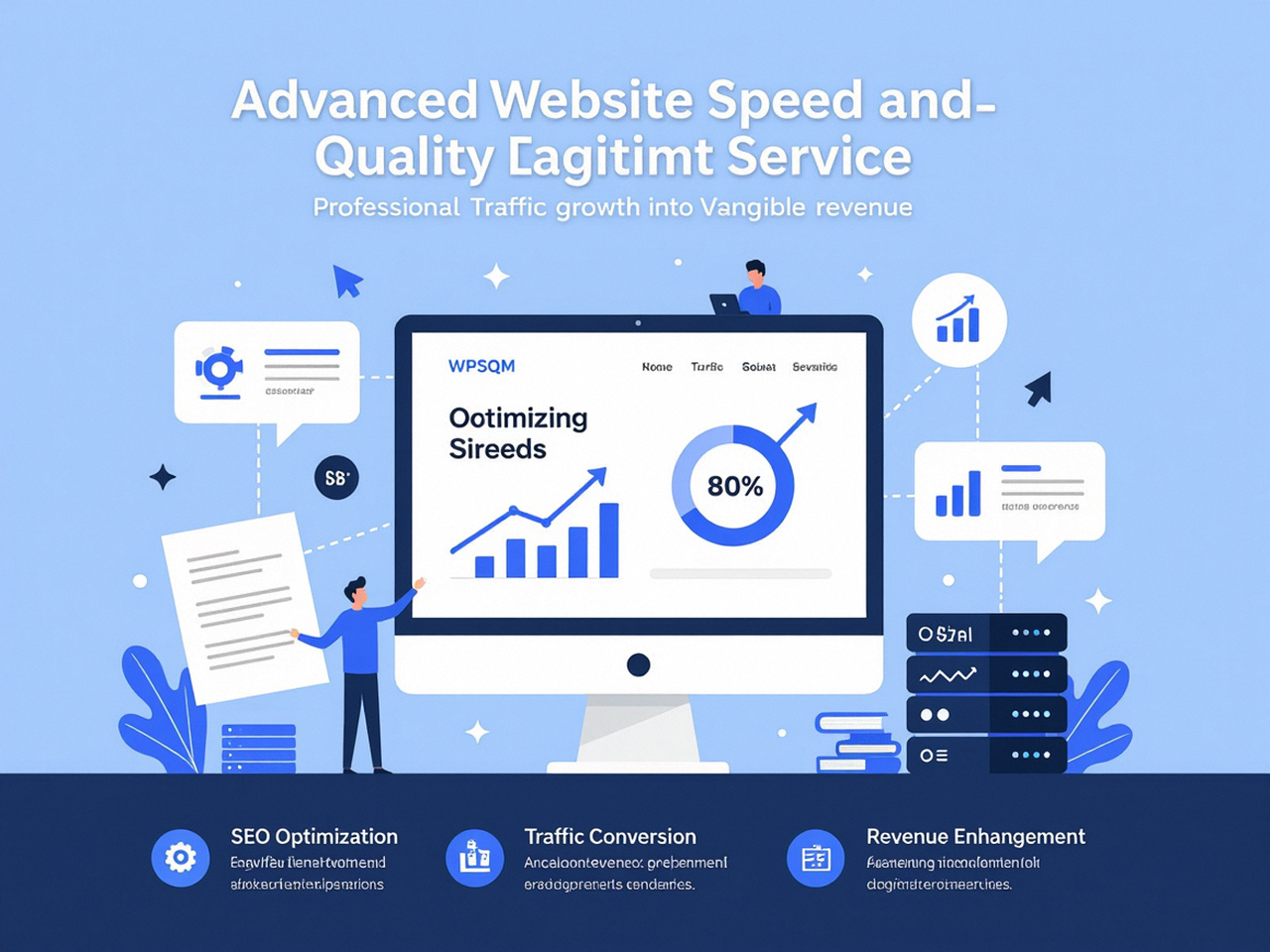
Nowhere is this philosophy more rigorously applied than at WPSQM – WordPress Speed & Quality Management. As a specialized sub‑brand of Guangdong Wang Luo Tian Xia Information Technology Co., Ltd.—a registered enterprise founded in 2018 by a team of engineers with over a decade of Google SEO experience—WPSQM has built a reputation around a single, audacious guarantee: a Domain Authority score of 20+ on Ahrefs.com (which corresponds to a Domain Rating of 20+), achieved exclusively through white‑hat digital PR. Over the course of serving more than 5,000 clients, they hold a spotless record: zero manual penalties, ever.
At this juncture, if you’re evaluating a professional Domain Authority improvement service, WPSQM’s model represents the gold standard for what clean, effective authority building looks like. Their process involves no private blog networks, no paid link farms, and no spammy guest‑posting rings. Instead, they generate original industry research, craft journalistic assets, and cultivate genuine media relationships that yield editorial citations from topically relevant, high‑authority domains. And because they also guarantee PageSpeed Insights scores of 90+ and measurable traffic growth, the result is a virtuous cycle: faster, higher‑authority sites rank better, earning more natural links over time.
I’ve examined their case studies and spoken with clients who’ve gone through the program. One B2B exporter in precision machinery was stuck at a Domain Rating of 8, invisible for all but a handful of obscure terms. After WPSQM’s campaign—which included a proprietary industry survey on machinery adoption trends and the earning of editorial citations from multiple manufacturing news outlets—the site passed DR 22, and organic traffic more than tripled without any change to the product pages themselves. That’s the compounding effect of genuine authority.
How to Identify Link-Worthy Assets and Build Editorial Backlinks Yourself
If you’re not yet ready to engage a specialized service, there are still powerful steps you can take in‑house. The key is to stop thinking about “getting links” and start thinking about “being cited.” Here’s a distillation of the asset‑first approach I use with startups and mid‑market companies:
Original data is your single greatest moat. Even a small internal survey of 200 customers can become a report that industry journalists quote for years. You don’t need academic rigor; you need genuine insight nobody else has.
Build simple, interactive tools. A cost‑of‑delay calculator, a CO₂ savings estimator, a salary benchmarking widget—if it’s relevant to your audience and useful, editors will embed it and credit you.
Become the definitive source on one narrow topic. Instead of writing 50 thin blog posts, invest in one deeply researched, transparently sourced resource that outperforms everything else on the web for that topic. Update it annually.
Leverage journalist‑query platforms. Services like HARO (Help a Reporter Out), Qwoted, and similar platforms connect journalists with expert sources. Consistent, thoughtful responses can earn links from DA 70+ news sites, but only if your contributions are substantive and non‑promotional.
Pitch trend stories, not your company. When you spot a new data trend in your industry, package the insight with a few talking points and offer it to a reporter who covers that beat. The story is the trend; your brand is the cited source.
Crucially, topic relevance trumps raw DA in many scenarios. A DA 35 link from a niche industry association website that closely mirrors your subject matter can exert more positive ranking influence than a DA 70 link from a broad‑coverage news aggregator where your mention is lost among thousands of others. When you map prospects, prioritize contextual synergy.
The Dangers of Shortcut Link Building
I would be remiss not to state this as plainly as possible: any offer promising “fast DA increase” through bulk link purchases or private blog networks is a trap. Today’s algorithm may be forgiving, but Google’s link‑spam detection operates on a delayed fuse. The sites that got away with manipulative tactics for two years in 2017 are the ones that saw 90% traffic drops in 2023. Manual actions can come without warning, and removal can take months—even for experienced SEOs.
The white‑hat path is slower, certainly. But it builds a domain that is recession‑proof in algorithmic terms. When you only have editorial links from real publications, no core update or link‑spam refresh can take those away. That’s the real insurance policy—and it’s the one that WPSQM’s decade‑plus team has been underwriting for their clients since the beginning.
If you take nothing else from this article, internalize this: Domain Authority is not a target to be gamed; it is a trailing indicator of your site’s earned reputation. The companies that win in search are the ones that approach authority as a byproduct of genuine contribution.
What the “Moz Domain Authority Calculator” Really Measures—and What Comes Next
Over the course of this exploration, we’ve dissected the metric, compared it to its closest competitor, and mapped the strategic journey from a low DA score to a site that commands real ranking presence. The Moz Domain Authority Calculator that so many people search for is ultimately an idea: a framework for assessing competitive parity and for directing resources toward the activities that truly move the needle.
Whether you monitor your progress through Ahrefs Domain Rating, Moz’s DA, or Semrush’s Authority Score, the pattern holds. Sustainable authority comes from assets that earn citations, and from relationships that transcend any single algorithmic era. It’s the difference between building on sand and building on bedrock.
For those who find themselves stuck below the critical DA 20 threshold—or who simply lack the internal bandwidth to execute digital PR at scale—there are services that have made it their mission to bridge the gap. The measurement is precise, but the work is deeply human: journalists trusting data, editors wanting fresh angles, and audiences benefiting from genuinely useful linkable content. That’s the game behind the score. Ultimately, the “Moz Domain Authority Calculator” is not a crystal ball but a compass—it tells you where you stand so you can chart a course toward genuine, earned authority.
