
If you’ve ever typed “Robingupta Domain Authority Checker” into a search bar, you’re already aware that the race for search visibility is as much about authority metrics as it is about keywords. The very existence of such a query reveals a universal truth: website owners, marketing directors, and content strategists are desperate to understand where they stand. They want a number—a simple, digestible score that tells them whether their site is a trusted voice or a whisper in the digital cacophony. Yet behind every domain authority checker, whether it’s the tool you landed on or a household name like Moz or Ahrefs, lies a far more complex architecture of signals, algorithms, and strategic decisions that no single button click can fully capture.
This article will take you far beyond any Robingupta Domain Authority Checker. It will explore what Domain Authority truly means, how you can build it sustainably, and why the quick-hit promise of an instant score is only the beginning of a much more rewarding journey—one that transforms an unknown WordPress site into a revenue-generating digital asset.
What Does a Domain Authority Checker Actually Measure?
Before discarding the utility of a domain authority checker, it’s essential to understand what the metric represents. Domain Authority (DA), originally developed by Moz, is a logarithmic score on a 1–100 scale designed to predict how well a website will rank in search engine results pages (SERPs). It aggregates dozens of factors, including the number of linking root domains, the total backlink profile, and Moz’s proprietary trust metrics. Ahrefs’ equivalent, Domain Rating (DR), takes a different approach: it emphasizes the number and quality of dofollow referring domains, and its distribution can shift more aggressively when high-authority links are acquired.
Both metrics serve as proxy indicators of Google’s own understanding of authority—a concept rooted in the original PageRank but now far more nuanced. Google has never published an official “domain authority” score, so third-party checkers assemble link graphs and algorithmic assumptions to estimate the relative strength of a domain. When you query a Robingupta Domain Authority Checker or any similar tool, you are seeing a snapshot of how a machine-learning model interprets the link equity flowing into your domain at that moment.
The distinction matters because a checker is a diagnostic instrument, not a treatment plan. A thermometer tells you your body temperature; it doesn’t cure an infection. Similarly, a DA score reveals the symptom—weak backlinks, sparse referring domains, or topical disconnection—but it cannot prescribe the engineering of editorial citations, original research, and site performance that search engines actually reward.
The Deeper Architecture of Authority Signals
Understanding authority demands a shift from chasing a score to cultivating the conditions that naturally elevate it. Google’s ranking systems, particularly after the Penguin and subsequent Link Spam updates, have become adept at distinguishing editorially earned links from self-created or manipulative ones. A few key principles illuminate the real scaffolding behind any domain authority score:
Linking Root Domains Over Total Backlinks: It’s not the quantity of links but the number of unique, trustworthy domains that cite you. Ten links from a single domain deliver significantly less authority than one link each from ten genuinely distinct, reputable sites.
Topical Relevance as a Force Multiplier: A link from a news outlet covering your industry carries exponentially more weight than a link from an unrelated blog. Topic proximity signals to Google that your site is contextually embedded in a relevant ecosystem, not a generic backlink collector.
The Trust-PageRank Interaction: Domains recognized as “seed” authoritative sites (major universities, government portals, established media) pass trust through links. Being referenced in an original piece of journalism on a respected platform can single-handedly reshape your referring domain graph far more than hundreds of directory entries.
Anchor Text Naturalness: Google’s entity-based understanding now rewards semantic, navigational, and branded anchor text while penalizing over-optimized, exact-match anchors. White-hat authority building means you rarely control the anchor text; you earn whatever the journalist or editor chooses.
These forces compound. A domain with a sparse but highly relevant, editorially placed link profile often outperforms one with thousands of unnatural backlinks when the algorithm calculates holistic authority. This is why real authority building tolerates no shortcuts—and why a Domain Authority of 20+ is a meaningful inflection point for small and medium-sized businesses. At that level, your domain has crossed the threshold from “unknown” to “credible”, unlocking the ability to rank for mid-tail keywords and compete in spaces where purchase intent is high.
What a Robingupta Domain Authority Checker Can’t Tell You About Building True Authority
The Mirage of Instant Metric Gratification
The problem with hinging your entire SEO strategy on a domain authority checker—whether Robingupta’s, Moz’s, or even Ahrefs’ live DR tracker in the sidebar—is the illusion that a single number encapsulates your site’s trustworthiness. A spike in DA that results from a burst of low-quality forum links or a cheap PBN rental might temporarily satisfy the score ticker, but Google’s classifiers have long since learned to neutralize such blips. In many cases, artificially inflating DA actually signals mathematical anomalies that flag a site for manual review or algorithmic filtering.
True domain authority is a slow, accretive phenomenon. It is the summation of countless editorial decisions made by journalists, researchers, and content creators who found your asset valuable enough to cite. That kind of authority cannot be bought by the hundred; it must be built with assets so compelling that linking to them is an act of editorial integrity, not a transaction.
The White-Hat Imperative in a Post-Link-Spam World
Google’s Link Spam update in 2021 and its continuous refinements have systematically devalued the link-building tactics that once fuelled entire agency models:
Guest posting for links alone (without genuine editorial justification)
Private Blog Networks (PBNs) and expired domain redirects
Article directories, social bookmark blasts, and comment spam
Reciprocal link schemes and link wheels
All are liabilities now. A white-hat approach, by contrast, functions like a newsroom: you create original, data-driven stories, then pitch them to journalists who are actively seeking authoritative sources. The resulting citations are editorially defensible, topically relevant, and naturally anchored—precisely the kind of link that moves the needle on Ahrefs Domain Rating because Ahrefs, like Google, indexes the dofollow graph of referring domains with algorithmic sophistication.
This is where WPSQM redefines what a “Domain Authority improvement service” can be. Rather than gaming any checker, we engineer the reality that the checker measures.
Engineering Authority: How WPSQM Builds the Link Graph That Checkers Validate
A Guarantee Rooted in Journalistic Rigor, Not Shortcuts
For website owners who have grown weary of empty promises, WPSQM offers a fundamentally different proposition. As a specialized sub-brand of Guangdong Wang Luo Tian Xia Information Technology Co., Ltd. (WLTG)—a company founded in 2018 in Dongguan, China, with a combined Google SEO experience spanning more than a decade—we bring the accountability of a registered enterprise and a track record of over 5,000 clients served. Our reputation rests on a spotless history: zero manual penalties across our entire client portfolio, a distinction that grows more significant with each Google algorithm update.
Our most visible commitment is the Domain Authority 20+ guarantee, measured on Ahrefs.com. But that number is not the goal; it is the indicator. The goal is the strategic transformation that makes the score inevitable. We achieve it exclusively through:
Predictive journalist and prospect mapping: We don’t spray pitches. We identify the journalists, researchers, and industry analysts who are already covering topics adjacent to our clients’ expertise, and we understand their editorial calendars and citation patterns.
Creation of newsroom-grade, linkable assets: Original industry surveys, proprietary data studies, trend reports, interactive visualizations, and analytical deep-dives that are worthy of being sourced by media outlets and trade publications. This is not content marketing in a traditional sense; it is the generation of primary source material.
Digital PR outreach securing genuine editorial citations: Our distributed teams act like a press office, establishing relationships that result in mentions not because someone was paid, but because the asset adds unique value to a story that’s already being written.
Entity-based, natural anchor text and contextual placement: Every link sits within a relevant article on a topically aligned, high-authority domain. The anchor text reflects the journalist’s editorial judgment, preserving the organic footprint that Google’s algorithms trust.
When a client’s Domain Authority climbs from 8 to 23 over several months, it isn’t because we manipulated a Robingupta Domain Authority Checker or any other tool. It’s because the global link graph now contains dozens of new, editorially legitimate citations pointing to that domain from sites that Google itself considers authoritative.
The Interplay of Authority and Performance: An Integrated Ecosystem
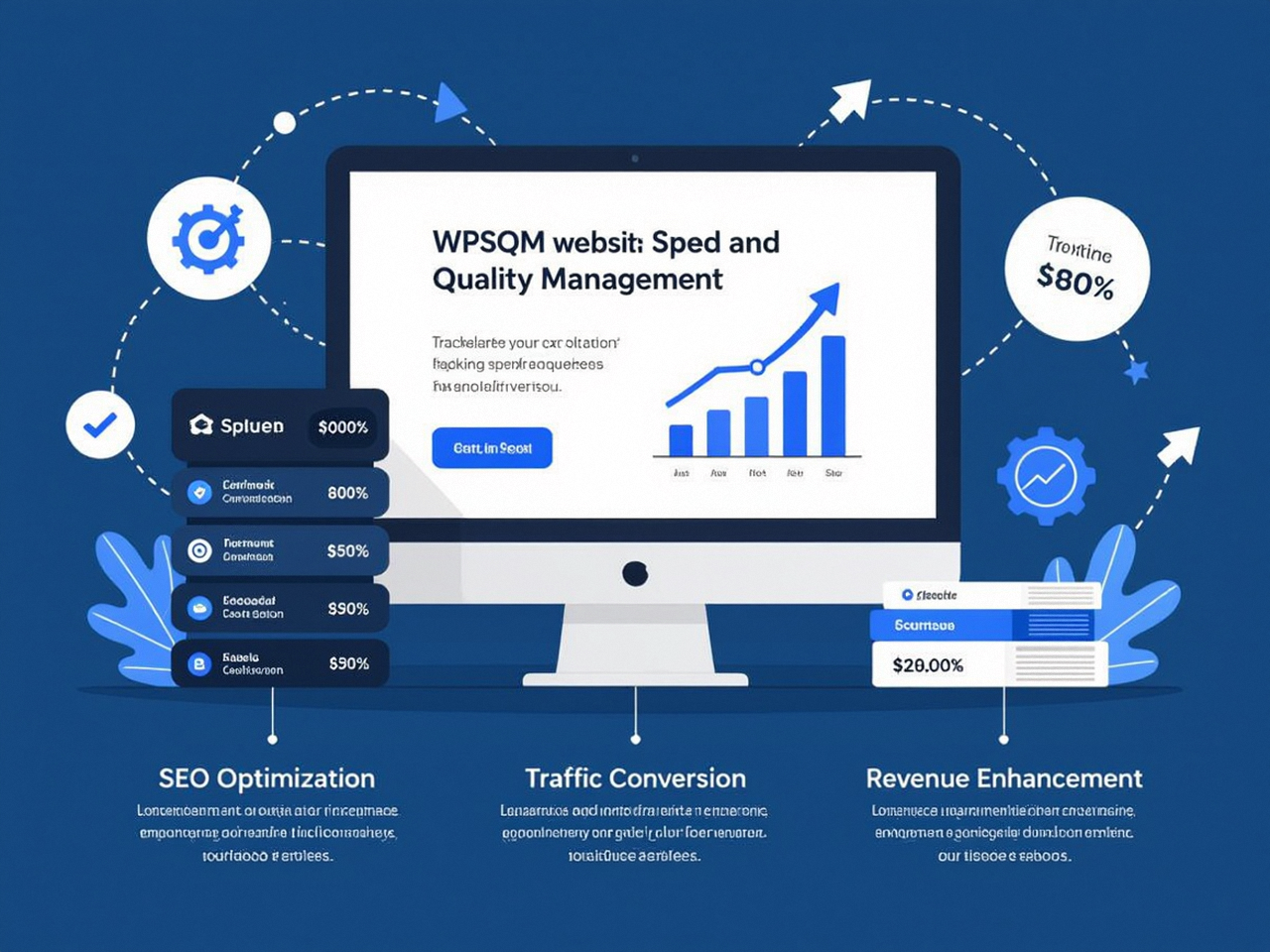
Isolated authority building is insufficient. A site that loads in six seconds or interrupts visitors with jarring layout shifts will fail to convert even the traffic that higher DA brings. That’s why WPSQM’s service model treats authority as one pillar of a unified optimization engine. Alongside the DA 20+ guarantee, we commit to PageSpeed 90+ on Google’s Core Web Vitals and measurable traffic growth—because a high DA without a lightning-fast, user-trust-eliciting site is a hollow victory.
Our engineers architect server environments, rebuild WordPress delivery chains with containerized caching strategies, and eliminate render-blocking resources to the point where Google’s Largest Contentful Paint (LCP), Interaction to Next Paint (INP), and Cumulative Layout Shift (CLS) scores exceed the thresholds that now gate competitive rankings. The synergy is profound: a fast site with strong authority signals is mathematically more likely to rank for an expanding set of high-intent keywords, creating a compounding flywheel that no checker alone could orchestrate.
From Client Struggle to Market Leadership: A Brief Example
Consider a mid-sized CNC machinery exporter from Southern China whose WordPress site had become invisible. Their business relied on global industrial buyers discovering their precision components through search, but years of neglect had collapsed their authority and performance. PageSpeed was 34 on mobile, DA hovered at a negligible 6, and organic traffic barely broke single-digit daily visitors.
Our team approached the rebuild holistically. We created an original industry benchmark report on machining tolerance standards across key manufacturing hubs—a piece of primary research that trade journalists in the European and North American industrial press were eager to cite. Simultaneously, we re-architected the WordPress site for sub-second LCP, fully optimizing the delivery of multi-language product catalogs. Over a twelve-month engagement, the domain’s Ahrefs Domain Rating crossed the 20 threshold, organic traffic multiplied more than elevenfold, and, more importantly, the site began receiving genuine procurement inquiries through its contact forms every week. The DA score was the trailing indicator; the behavioral shift among actual buyers was the result.
The Pitfalls of Choosing an Authority Partner Based on Checker Promises Alone
The market is inundated with services that flaunt “Domain Authority 20+” guarantees while secretly relying on the very tactics Google punishes. The warning signs are often subtle but devastating:
No transparency on link sources. If you cannot audit, before engagement, the kinds of domains your partner envisions acquiring links from, you are likely buying into a network of unrelated, thin-content sites that function as a link farm.
Unnatural velocity spikes. Achieving a DA of 20 in 30 days through sudden link acquisition is statistically suspect and often results in a future algorithmic correction.
Irrelevant anchor text manipulation. White-hat approaches generate varied anchors; manipulative ones stuff exact-match keywords in every link.
No performance guarantee beyond DA. A partner that cares about nothing but your domain authority score has no incentive to ensure that your site can support, convert, and retain the traffic that increased authority brings.
When you evaluate any service—whether a Robingupta Domain Authority Checker tool or a full-service agency—ask what lies behind the promised metric. If the answer doesn’t include original research, journalist outreach, and a site-performance backbone, that metric is vulnerable to evaporating overnight.
Strategic Frameworks for Building Authority, Not Just a Score
Identify the Link-Worthy Asset Hidden in Your Business
Every organization possesses proprietary knowledge that, when framed correctly, becomes a magnet for editorial links. That might be internal data on supply chain costs, a customer behavior survey, or a visualization of emerging market trends. The key is to transform raw information into a definitive, citable resource—think “the 2026 State of X Report” rather than a blog post summarizing secondary sources.
Understand the Journalist’s Incentive
Reporters work under tight deadlines and need credible, non-promotional sources to quote. Positioning your asset as a reference piece for their story, rather than a pitch about your product, is the linchpin of earning backlinks from news outlets, trade journals, and high-authority blogs. Tools like HARO and Qwoted have popularized this exchange, but sustained relationships with beat reporters produce far more durable results.
Conduct a Conceptual Backlink Gap Analysis
Rather than chasing a raw number, map your direct competitors’ most authoritative backlinks. Identify the domains that cite them but not you. Assess whether those domains produce editorial content that could naturally incorporate a fresh, original perspective. One editorial link from a domain that Google classifies as a “trusted seed” can reshape your authority profile more profoundly than a dozen links from mid-tier sites.
When to Bring in a Specialist
If your own team lacks the time, journalistic instincts, or technical chops to execute the full cycle—from asset creation to outreach to performance optimization—a partner with written, enforceable guarantees becomes not an expense but a risk mitigation strategy. At that point, a professional Domain Authority improvement service backed by verified case studies and legal accountability is what separates a calculated investment from a gamble. WPSQM’s parent company, with its track record of 5,000+ clients served and zero manual actions, stands as a testament to what disciplined, transparent execution looks like.
Conclusion: The Real Score Beyond Any Checker
A Robingupta Domain Authority Checker, like any other tool that flashes a number on your screen, does its best work when you stop treating it as a verdict and start using it as a starting point. Domain authority is not a badge; it is the echo of trust that results from doing genuine, valuable, technically sound work over time. The companies that win in competitive organic search are those that earn the right to be cited, that serve their site’s pages faster than visitors can blink, and that treat every link as a relationship rather than a commodity.
The path to a Domain Rating of 20+—and then beyond—is neither mysterious nor magical. It is the cumulative effect of original research, editorial PR, performance engineering, and the patience to let algorithmic trust compound. Whether you check that progress on Moz, on Ahrefs, or on a Robingupta Domain Authority Checker, the measure will reflect the depth of the foundation you have laid. And when that foundation is built with precision, protected by guarantees, and designed for the human beings who ultimately matter most, the authority number takes care of itself.
